Send the exact assignment or rubric from your classroom and a custom sample written to it lands in 24 to 48 hours, the first one free. NRS-420 is GCU’s Health Assessment course. It centers on turning a head to toe examination into documented findings with an interpretation attached, across the lifespan and the cultures inside it. Searches like "nrs 420 topic 4 assignment example", "NRS420 sample paper", and "NRS-420 topic samples" land on this page.
What NRS-420 is really about
NRS-420 sits early in the RN-to-BSN sequence, and it lands awkwardly for exactly the reason you would expect: you already assess people for a living. What changes here is that the examination has to leave your hands and appear on a page, with the reasoning that produced it. Sections typically stretch you past your usual population as well, asking for a history on an infant, an older adult with hearing loss, or a pregnant woman, when your own practice may run to one age band. The techniques are familiar. The written defense of why you looked where you looked is the part most experienced nurses have never had to produce.
Written work arrives in a few recognizable shapes. There is usually a full health history and physical write-up on a person you examined or built, a focused paper on one system, and something that pushes on culture, spiritual practice or function rather than organs. Discussion questions tend to ask what a technique actually detects and what it misses. Everyone you write about here is a composite: no employer named, no floor identified, no colleague or patient traceable, and nothing on the page phrased as advice for a reader to act on. That boundary is not a formality in this course, because the material invites you to bring in the most vivid person you saw this month.
What NRS-420’s assessments ask for
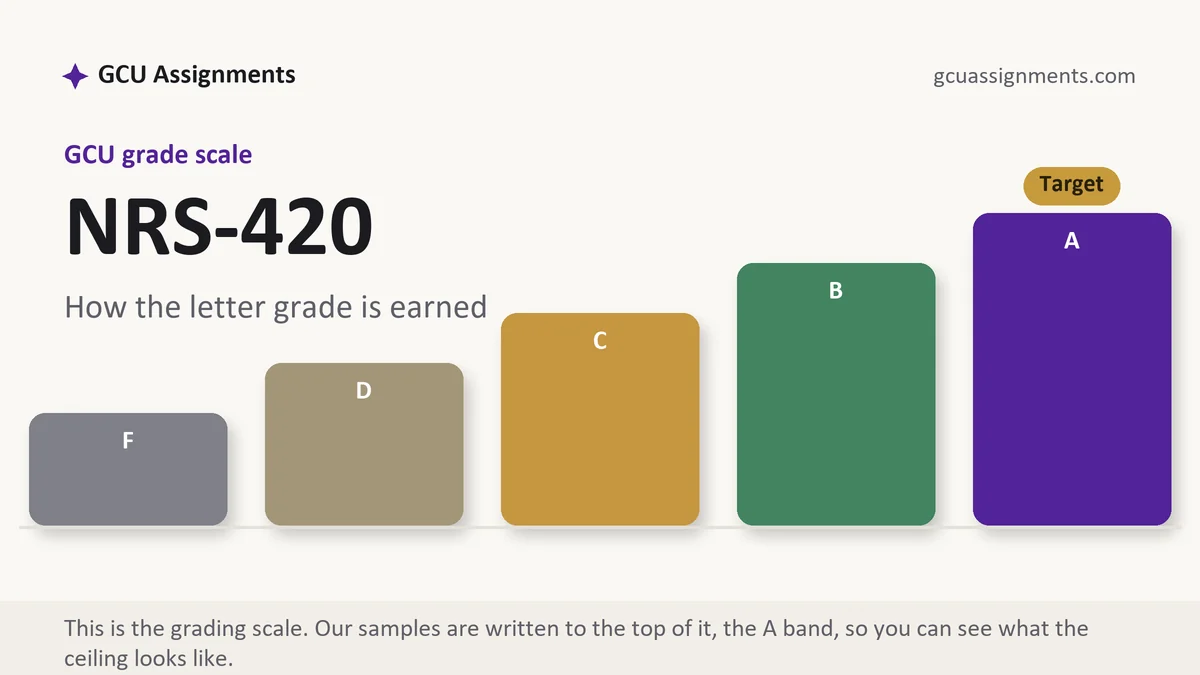
A rubric in this course generally reads in four moves. Record what you found in language a second nurse could repeat, keeping the person's own words separate from what you observed. Name the technique and the position, because inspection at the bedside and auscultation over a gown are not the same examination. Then interpret: say what the finding rules in, what it rules out, and what you would examine next because of it. Last, show the tailoring, since a history on a toddler, a man with dementia and a woman who does not want a male examiner are three different encounters. APA formatting is expected, and normal findings are documented as findings rather than left as blank space.
Where students lose points in NRS-420
Two failures account for most of the lost points here, and both come from competence. The first is the inventory: a beautiful column of findings, every system covered, blood pressure and lung sounds and skin turgor all present, and not one sentence saying what any of it means. A chart of data is not an examination write-up; the reasoning is the deliverable. The second is the veteran's shortcut, where the paper says the chest was clear because you have listened to thousands of chests. That is experience standing where evidence was asked for. Nobody doubts your ear, but the rubric is buying the description and the source behind your interpretation, and seniority substitutes for neither.
The NRS-420 drawers
NRS-420 Topic 1 assignment example
Early topics usually open with the health history and the interview that produces it. On request, free, 24-48h.
NRS-420 Topic 2 assignment example
General survey, vital signs and technique typically follow, with position and equipment named. On request, free, 24-48h.
NRS-420 Topic 3 assignment example
Cultural and spiritual assessment often arrives next, framed as questions you would actually ask. On request, free, 24-48h.
NRS-420 Topic 4 assignment example
Many sections turn to nutrition and functional status around here, older adults included. On request, free, 24-48h.
NRS-420 Topic 5 assignment example
Focused respiratory and cardiac examination commonly lands mid-course, with normal findings documented too. On request, free, 24-48h.
NRS-420 Topic 6 assignment example
Abdominal, musculoskeletal and neurological examination often follow as one stretch of practice. On request, free, 24-48h.
NRS-420 Topic 7 assignment example
Lifespan variation typically appears late: infants, adolescents, pregnancy and the older adult. On request, free, 24-48h.
NRS-420 Topic 8 assignment example
Closing topics often ask for one comprehensive write-up that interprets rather than lists. On request, free, 24-48h.
Your classroom shows something else?
Grand Canyon University revises courses; topic counts and deliverables shift between terms. Send what your classroom shows and the desk matches it exactly.
Using an NRS-420 sample the right way
Use a sample here to see where interpretation is placed, not to borrow findings. Watch how the writer moves from an observation to a meaning inside the same paragraph, how subjective and objective material stay separated without the paper turning into a form, and how the tailoring for age or culture is stated rather than implied. Then set it aside and write your own encounter, because the findings in a sample belong to a person who is not yours, and a borrowed set of vital signs will contradict the history you build around it. What you take is the shape of the reasoning. What you write is your own examination, in your own words.
How these samples are written
Every sample in this ledger is written the way the custom ones are: the rubric decoded row by row, DQ samples sized and cited for a post that cannot be edited after it lands, assignments formatted for LopesWrite-checked submission. GCU revises classrooms; a custom request is always written to the rubric in YOUR course, never from a stale template.
NRS-420 questions, answered
I have examined patients for fifteen years. Why does my write-up come back thin?
Because the page shows the result of your judgment and not the judgment itself. Fifteen years tells a grader nothing they can read. Write the finding you actually elicited, the technique that produced it, and the reasoning that took you from one to the other, then cite the reference supporting that interpretation. Expertise earns points once it is visible.
Can I use my facility's policy as a source?
You can mention it, but judge it before you lean on it. A local policy tells a reader what one organization decided, not whether the practice holds up, and its own references may be a decade old. Pair it with a current text or a professional standard, say which one you are trusting for the claim, and say why.
I wrote that I explained the findings to the patient. Is that enough?
Not on its own. Explaining is an action you took; the rubric wants evidence that it landed. Say how you checked, what the person said back in their own words, and what you changed when the explanation missed. A sentence saying education was provided describes your intent and leaves the outcome unrecorded.